

Review Management for Small Business: How to Earn Authentic Reviews and Build Customer Trust
Build a trustworthy review process for your small business. Learn when to ask, how to respond and how to stay within platform policies.

IN THIS ARTICLE
- Why review management should be part of daily operations
- Build an ethical review request process
- Create a simple review operating system
- Respond to positive, neutral and negative reviews
- Turn repeated feedback into operational improvements
- Track metrics without becoming obsessed with stars
- Create ownership and escalation rules
- Where Noxtill Reviews & Reputation fits
- Frequently asked questions
- The bottom line
Review management for a small business is a repeatable process for asking customers for honest feedback, monitoring reviews, responding professionally and correcting recurring service issues. Requests should be neutral and follow each platform’s policies.
A customer’s review is more than a public rating. It is a description of an experience that another person may use when deciding whether to call, visit, book or buy. For a small business, reviews can reveal what customers appreciate, where expectations are not being met and which operational problems keep appearing. They can also expose a gap between what a business promises and what a customer actually experiences.
That makes review management an operating discipline, not a campaign to collect as many five-star ratings as possible. A sustainable process asks customers for honest feedback in a consistent way, gives the business a chance to listen, responds with care and routes recurring issues to the people who can fix them. It must also respect the policies of the platforms where reviews appear and the rules that apply to endorsements and testimonials.
This guide explains how to build that process, what to automate, how to respond to difficult feedback and which measures matter. It does not recommend buying reviews, filtering customers by likely sentiment or offering rewards for positive ratings. Google prohibits incentives in exchange for reviews and says reviews must reflect genuine experiences. [1] The US Federal Trade Commission also prohibits certain fake reviews and incentives conditioned on a particular positive or negative sentiment. [2]
Why review management should be part of daily operations
Customers often read reviews to understand the experience a business provides. They may look for details about communication, punctuality, product quality, cleanliness, staff professionalism, delivery or problem resolution. A rating alone cannot explain these details. The business needs a process for reading the words, identifying patterns and acting on what they reveal.
Without a clear process, feedback becomes scattered. One employee checks a listing, another sees a social message, and the owner discovers a negative review weeks later. Responses may be inconsistent or defensive. Positive comments may never be acknowledged, while a repeated service issue is treated as an isolated complaint. A shared workflow makes feedback visible and gives each review a clear owner.
Review management has three connected outcomes: help potential customers understand real experiences, help current customers feel heard and help the business improve. Treating only the first outcome as important is a mistake. A review program that increases volume without improving the underlying experience can create more public evidence of the same unresolved problem.
Build an ethical review request process
Ask consistently, not selectively
Create a neutral request process that applies to customers based on an ordinary business event, such as a completed appointment, delivered order or resolved service visit. Do not send requests only to people who gave a high satisfaction score or only to customers whom staff believe will leave a positive review. Selective solicitation can distort the public picture and may breach platform rules. Use the same invitation standard for comparable customer interactions.
Choose a sensible moment
Ask after the customer has had a fair opportunity to experience the service or product. For an appointment business, that might be after the visit is complete. For a delivered product, it may be after delivery and a reasonable period of use. The right timing varies by business, so test whether the request feels helpful rather than intrusive. Avoid repeated reminders that pressure customers who have chosen not to respond.
Use neutral language
A request should invite honest feedback, not prescribe the rating. For example: “Thank you for choosing our business. Your honest feedback helps us understand what went well and what we can improve. You can share your experience here: [review link].” Do not say “Please leave us five stars,” “Only share positive feedback” or “Contact us privately if you are unhappy instead of posting a review.”
Do not pay for sentiment
Never make a reward conditional on a positive review, a five-star rating or the removal of criticism. Google explicitly prohibits incentives such as discounts or free goods in exchange for posting, revising or removing a review. [1] The FTC’s Consumer Reviews and Testimonials Rule addresses fake reviews and compensation conditioned on a particular sentiment. [2] Rules can differ by platform and jurisdiction, so a business should review the current requirements before launching any review-related promotion.
Create a simple review operating system
A practical workflow has five steps. First, define the completed event that triggers an invitation. Second, send a neutral request through an appropriate channel, such as email, SMS, WhatsApp or a QR code at the point of service, subject to applicable consent and platform requirements. Third, monitor incoming feedback. Fourth, assign an owner to respond. Fifth, classify recurring themes and route them to the team responsible for improvement.

Keep a small record of the request process: which customer event triggered the invitation, when it was sent, which channel was used and whether the customer opted out. This is not a request to pressure customers; it is a way to make the process consistent and prevent duplicate or excessive messages. Keep customer data limited to what the business needs and respect communication preferences.
Respond to positive, neutral and negative reviews
Positive reviews: acknowledge the detail
A good response is specific enough to show that the business read the review. Thank the customer, refer to a detail they mentioned and close in a natural tone. Avoid repeating the same generic paragraph under every review. Do not disclose private details about the customer or their transaction. If the review contains a public misconception, correct it politely without turning the response into an argument.
Example: “Thank you for taking the time to share this. We are glad the appointment ran on schedule and that the team explained the service clearly. We appreciate you choosing us.” This example is a template, not a real customer quote.
Neutral reviews: learn what was missing
A mixed review often contains a useful distinction: the product was good but delivery was slow, the appointment was helpful but the wait was long, or the staff were friendly but instructions were unclear. Acknowledge both sides and explain what the business will review. Avoid offering a resolution that has not been approved or promising a deadline that the team cannot meet.
Negative reviews: reduce friction, not accountability
Start by acknowledging the experience without assuming facts that have not been checked. Apologize when appropriate, state that the business wants to understand what happened and invite the customer to continue through an official private channel. Do not publish order numbers, phone numbers, health information, addresses or internal case details in a public reply.
A reliable response pattern is: acknowledge the concern, state the next action, provide a private contact route and then follow through offline. If the review alleges a safety issue, discrimination, fraud or another serious matter, route it to the appropriate manager or professional adviser. Do not let an automated reply publish a sensitive or legally significant response without review.
A business should also distinguish between a genuine negative review and content that may violate a platform policy. If there is a policy issue, use the platform’s formal reporting process and provide evidence. Do not ask staff, friends or vendors to retaliate with reviews.
Turn repeated feedback into operational improvements
The strongest review process does not end when a response is published. Classify themes such as communication, wait time, service quality, delivery, billing clarity, staff courtesy, scheduling and product expectations. Read the original review before relying on automated sentiment labels. A short comment can be ambiguous, sarcastic or context-dependent; a classification should help organize review, not replace it.
Look for themes that repeat over time. If several customers mention unclear arrival windows, the business may need better scheduling messages. If customers repeatedly describe surprise charges, review the quotation and checkout process. If positive comments consistently mention helpful staff explanations, capture that practice in training. This turns public feedback into a source of operational learning.
Assign each improvement an owner and a review date. Record the issue, the change being tested and the result. Avoid claiming that a single process change caused a rating increase unless the business has measured it carefully and considered other factors. Review volume, platform mix, seasonality and the type of customer may change over time.
Track metrics without becoming obsessed with stars
Useful measures include new review volume by platform, average rating by platform, response coverage, median response time, recurring feedback themes, request delivery and opt-out rates. Compare similar time periods and separate platforms because their audiences and rating systems differ. A combined average can hide a problem on one channel.
Response coverage is the share of eligible reviews that receive a reply. Median response time shows how quickly the team usually responds without being distorted by a few very old reviews. Theme frequency shows which issues appear most often. The goal is not to optimize every metric independently. For example, a very fast response that is inaccurate or defensive is not a quality response.
Use a balanced dashboard: what customers say, how quickly the business responds, which issues recur and whether the underlying process has changed. A rating may be visible, but customer trust is built through the experience behind it.
Create ownership and escalation rules
A review should not sit in a shared inbox with no clear owner. Define who monitors each platform, who can draft a reply, who approves sensitive responses and who is responsible for resolving the underlying problem. A routine question may be handled by a trained customer-service employee. A billing dispute may require a manager. A complaint involving personal safety, discrimination, privacy or a legal threat should follow the company’s escalation policy rather than an automatic response template.
Set a response service level that is realistic for the size of the team. It is better to commit to a reliable review cadence than to promise an instant reply that nobody can consistently deliver. For example, the owner might review new feedback every business day and assign urgent issues immediately. The exact timing is a business decision; it is not a universal benchmark.
Keep a private issue log that records the theme, owner, next action and resolution status without copying unnecessary personal information. When the business changes a process because of a review, record what changed and check later whether similar feedback continues. This creates a feedback loop between public reputation and everyday operations. It also prevents the team from treating each review as a one-off writing task.
Where Noxtill Reviews & Reputation fits
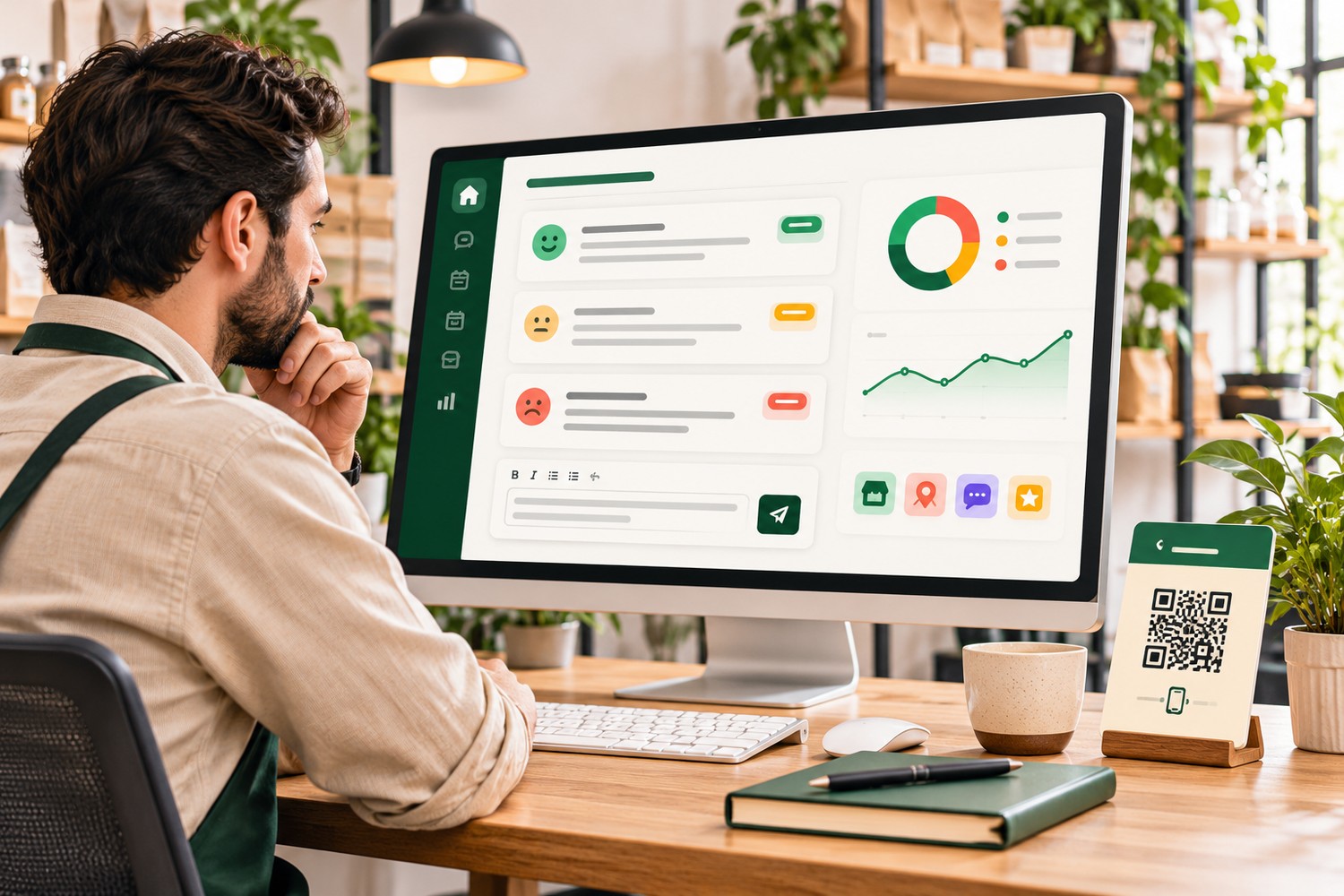
Noxtill’s public page describes review requests through WhatsApp, SMS, email and QR codes; monitoring and managing reviews across connected platforms; AI suggestions for replies; sentiment analysis; alerts; and review widgets for websites and other marketing placements. [3] These capabilities can support the operational loop, provided the platform connections and plan limits are verified for the customer’s actual setup.
Use automation to make invitations timely and monitoring consistent. Keep a human review step for sensitive replies, disputed facts and serious complaints. An AI suggestion should be checked for accuracy, privacy and tone before publication. Automated sentiment should be treated as a triage aid, not as the final interpretation of a customer’s experience.
A note on product examples: product pages and demos often show illustrative ratings, review totals and quotes. Treat them as examples of how an interface looks, not as verified customer proof, and judge any review tool on how its workflow performs with your own customers.
Frequently asked questions
How can a small business get more authentic reviews?
Deliver a consistent customer experience, ask all comparable customers neutrally after a meaningful interaction, make the review link easy to find and avoid incentives tied to positive sentiment. Follow the rules of each review platform.
When should a business ask for a review?
Ask after the customer has had a reasonable opportunity to experience the service or product. The timing should match the business model and should not become repeated pressure.
Can a business offer a discount for a Google review?
Google prohibits incentives in exchange for posting, changing or removing a review. The FTC also restricts incentives conditioned on a particular sentiment. Do not make a reward dependent on a positive rating. [1][2]
How should a business respond to a negative review?
Acknowledge the concern, avoid arguing or exposing private details, provide a suitable private contact route and follow through with the customer. Escalate serious complaints to the appropriate manager.
Is it okay to ask only happy customers for reviews?
A selective process can distort the feedback a public profile represents and may violate platform policy. Use a consistent, neutral process for comparable customer experiences.
Can AI write review replies?
AI can draft a response, but a person should verify facts, privacy, tone and any proposed resolution before publishing—especially for complaints or sensitive situations.
The bottom line
A trustworthy review program is built on genuine experiences, fair requests, thoughtful responses and visible improvements. A business cannot control every opinion, and it should not try to. It can control whether it asks honestly, listens carefully and acts on what customers tell it. Learn more about Noxtill’s Reviews & Reputation workflow.
NOXTILL FEATURES MENTIONED IN THIS GUIDE
SOURCES REFERENCED
- [1]Google Business Profile: Tips to get more reviews
- [2]FTC: Consumer Reviews and Testimonials Rule Q&A
- [3]Noxtill Reviews & Reputation
Examples in this guide are illustrative workflows, not customer case studies or promised results. Product capabilities, integrations and plan limits should be confirmed in the live product.


